

1. Model introduction
Stable Diffusion 3.5 Medium is the primary SD3 checkpoint used in miles-diffusion recipes. SD3 uses a DiT transformer with dual text-encoder conditioning (encoder_hidden_states +
pooled_projections).
Key highlights for RL training:
- Single DiT component — weight sync targets
--update-weight-target-module transformer(default). - LoRA on all attention projections (self-attn + cross-attn add projections).
- Supports Flow-GRPO (OCR) and DiffusionNFT (PickScore) objectives.
- Gated Hugging Face model — requires
HF_TOKEN.
2. Supported variants
Override family detection when the checkpoint name does not match a registered
pattern (e.g. a renamed local directory):
3. Environment setup
SD3.5 is gated — export your Hugging Face token:rockdu/miles-diffusion-datasets:
Launch scripts download the matching subset automatically via
command_utils.hf_download_dataset. Override the download root with
--data-dir (default /root/datasets →
/root/datasets/miles-diffusion-datasets).
4. Family config
Registered inmiles/backends/fsdp_utils/configs/sd3.py:
resolve_diffusion_model_family) matches --hf-checkpoint
names against hf_ckpt_name_patterns. --hf-checkpoint is the single source
for the HF repo / local directory used by both FSDP training and
sglang-diffusion rollout; pass --diffusion-model-family only to override the
auto-detected family.
SD3-specific training behavior
Rollout responses serialize SD3 conditions as single tensors (not lists),
unlike some multi-encoder families.
5. Launch
All recipes are Python modules underscripts/. Each exposes a Typer CLI
(ScriptArgs dataclass) and submits training through
command_utils.execute_train. Common overrides: --cuda-visible-devices,
--num-rollout, --data-dir, --extra-args.
5.1 Script inventory
5.2 Flow-GRPO + OCR (2 GPU colocate)
Canonical script:scripts/run_diffusion_grpo_sd3_ocr_sglang.py
Status: 🛡️ FG — Fully gated
tests/e2e/short/test_sd3_ocr_grpo_2xGPU.py.
5.3 DiffusionNFT + PickScore (3 GPU)
Script:scripts/run_diffusion_nft_sd3_pickscore.py
Status: 🛡️ FG — Fully gated
Recipe comparison
6. Recipe configuration
GPU layout
GRPO + OCR (default script): 2 GPUs colocated (--colocate); OCR on CPU Ray actors.
NFT + PickScore:
PickScore runs as a Ray actor pool on a dedicated GPU. With
--colocate-reward
(not used in the default script), reward workers share rollout GPUs at 0.05 GPU
per worker — useful only when GPU count is tight.
Algorithm flags
Flow-GRPO + OCR:
DiffusionNFT + PickScore:
7. LoRA and weight sync
Both SD3 recipes use LoRA with IPC weight sync:8. Precision notes
Both SD3 launch scripts use fp16 DiT forward:--diffusion-forward-dtype fp16, the FSDP actor automatically enables
ShardedGradScaler around backward / optimizer step (no extra flag — see
miles/backends/fsdp_utils/actor.py). bf16/fp32 forward disables the scaler.
Flow-GRPO recipes also set --diffusion-clip-range (e.g. 1e-4 in the OCR
script) to clip importance ratios during the policy update.
Train/rollout dtype alignment for Flow-GRPO is covered in
SDE step backend.
9. Reference results
Flow-GRPO + OCR
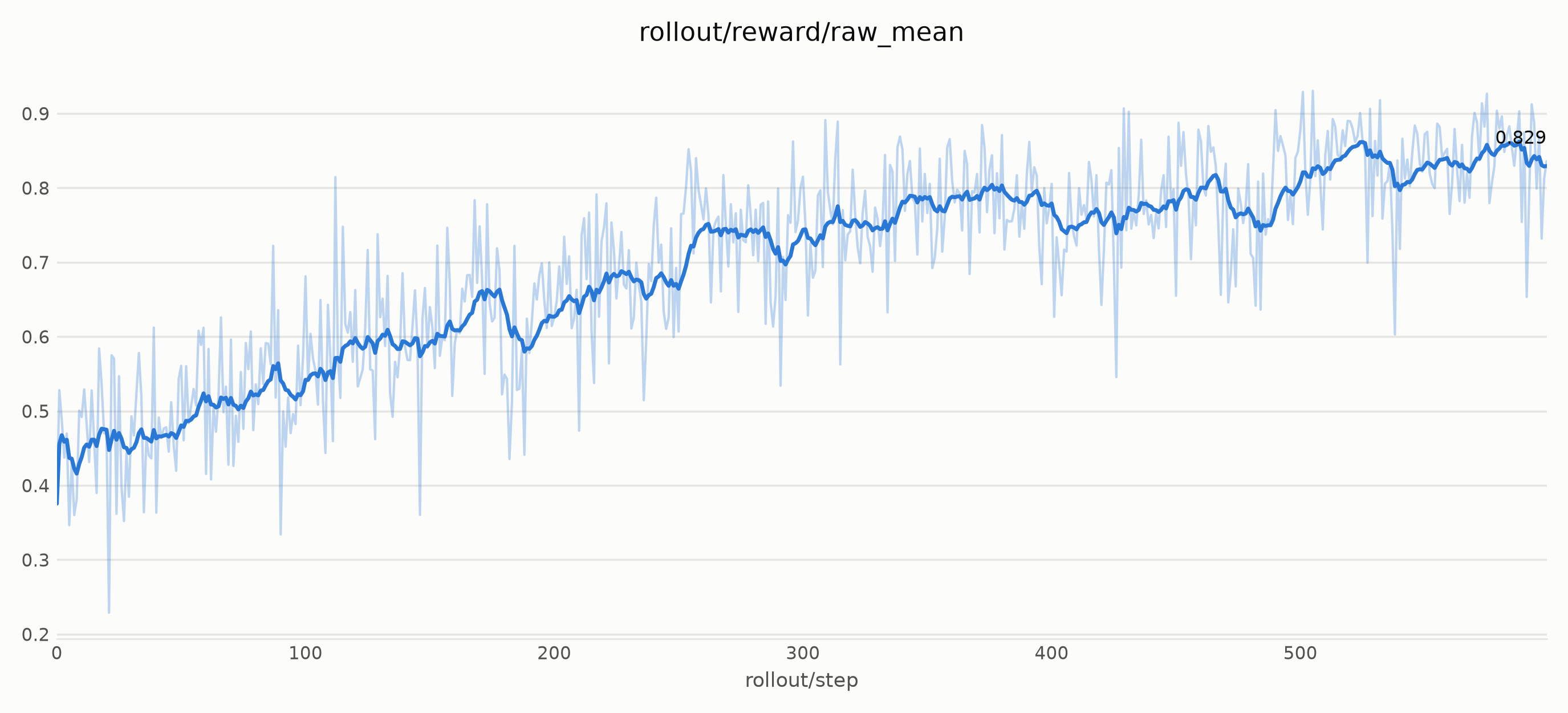
Observedrollout/reward/raw_mean from one
scripts/run_diffusion_grpo_sd3_ocr_sglang.py run (default batch, 600 rollouts). The curve is an example, not a CI
acceptance range:
miles-diffusion-grpo.
DiffusionNFT + PickScore
Observedrollout/reward/raw_mean from one scripts/run_diffusion_nft_sd3_pickscore.py run (100 rollouts):
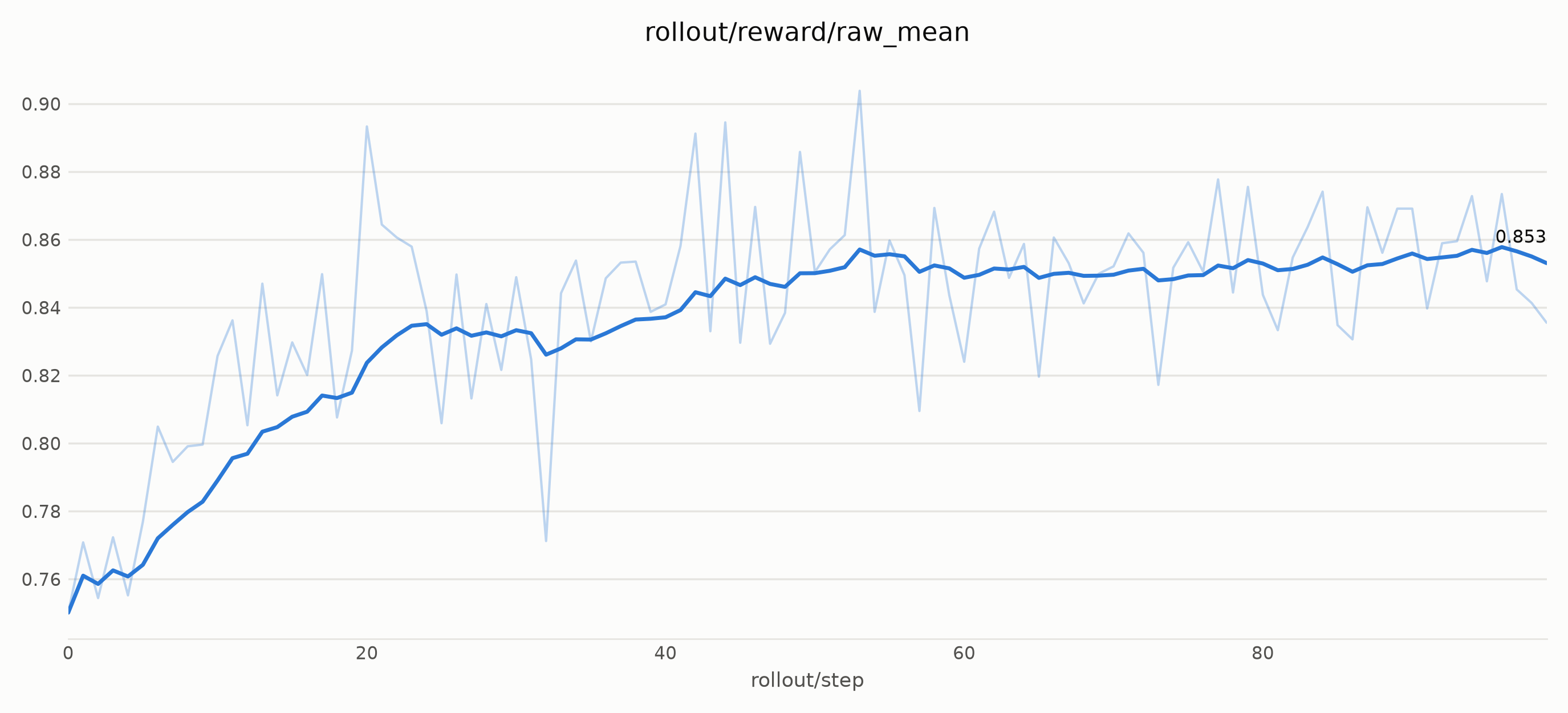
miles-diffusion-nft. That run observed held-out
eval/pickscore_test ≈ 0.78 with --eval-interval 30 and 50 denoise steps at eval time; this value is not asserted
by the E2E fixture.
10. Pairs well with
- Quick Start — SD3.5 Flow-GRPO OCR walkthrough.
- Rewards — OCR and PickScore scoring.
- Customization —
--*-pathplug-points. - SDE step backend — SDE window (GRPO) vs ODE (NFT).
- LoRA weight sync — IPC merge used by both recipes.