

Choose a precision
Rollout × training compatibility
Each row is a rollout (inference) precision; each column is the trainer’s forward precision. ✅ = supported; ✗ = not supported.
The reference script (
scripts/run_qwen3_30b_a3b.py) allows only one rollout
precision and one training precision at a time. Use paired rollout and training
flags for the end-to-end MXFP8 and NVFP4 recipes below.
Unified training recipe
The precision contract covers checkpoint conversion, the trainer forward pass,
SGLang rollout, and live weight export. High-precision tensor exceptions must
match across all four stages.
Modes
1. BF16 train + FP8 inference
The lowest-friction path. SGLang loads FP8 weights while the trainer keeps a BF16torch_dist checkpoint. There is precision drift between the two paths;
on MoE workloads, pair this with R3 (and optionally TIS).
examples/infra_features/low_precision/run-qwen3-4b-fp8.sh
— single-node Qwen3-4B. It serves an FP8 checkpoint to SGLang and trains from a
BF16 torch_dist checkpoint; it sets no --fp8-recipe, so the trainer forward
stays BF16.
2. Unified block-wise FP8 (DeepSeek-style)
Rollout and training share the same block-wise FP8 quantization. This is the recipe to use on Hopper, and the layout DeepSeek ships its FP8 checkpoints in. Block layout is 128×128 with FP32 scales.NVTE_FP8_BLOCK_SCALING_FP32_SCALES is set for you in the actor env
(miles/ray/train/actor_factory.py), defaulting by hardware: 1 on Hopper, and
0 on Blackwell, where TransformerEngine emulates the block-wise recipe with
MXFP8 and needs power-of-two scales. Override it only if you know you want the
non-default for your GPU.
For models that already ship 128×128 block-wise FP8 weights (DeepSeek-V3.2,
Qwen/Qwen3-30B-A3B-FP8), point --hf-checkpoint at the
block-wise FP8 directory and let SGLang autodetect. Otherwise convert with
tools/convert_hf_to_fp8.py.
For MoE workloads, also consider --use-rollout-routing-replay (R3). The
canonical recipe leaves it commented out by default but the flag is available.
Reference recipe:
examples/infra_features/low_precision/run-qwen3-30b-a3b-fp8-two-nodes.sh
— two-node Qwen3-30B-A3B.
3. Unified MXFP8 (Blackwell)
MXFP8 uses one-dimensional microscaling blocks: 32 consecutive E4M3 values share one UE8M0 scale. The end-to-end recipe uses MXFP8 for rollout, forward propagation, weight-gradient GEMMs, and data-gradient GEMMs while preserving configured tensors in BF16.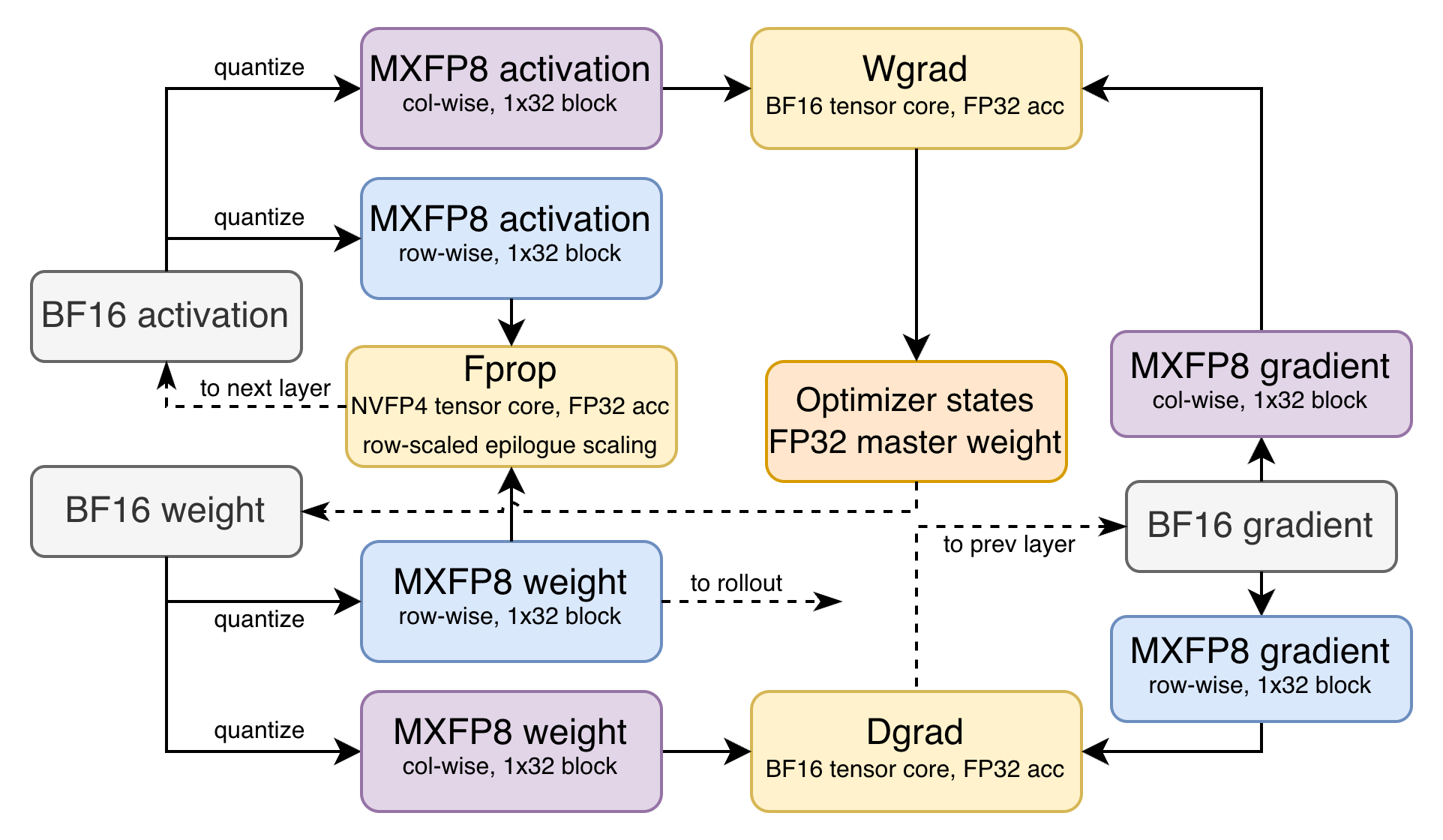
Choose the pair that matches the model, parallel layout, and installed SGLang
stack. Convert a checkpoint outside the launcher with:
4. NVFP4 (Blackwell)
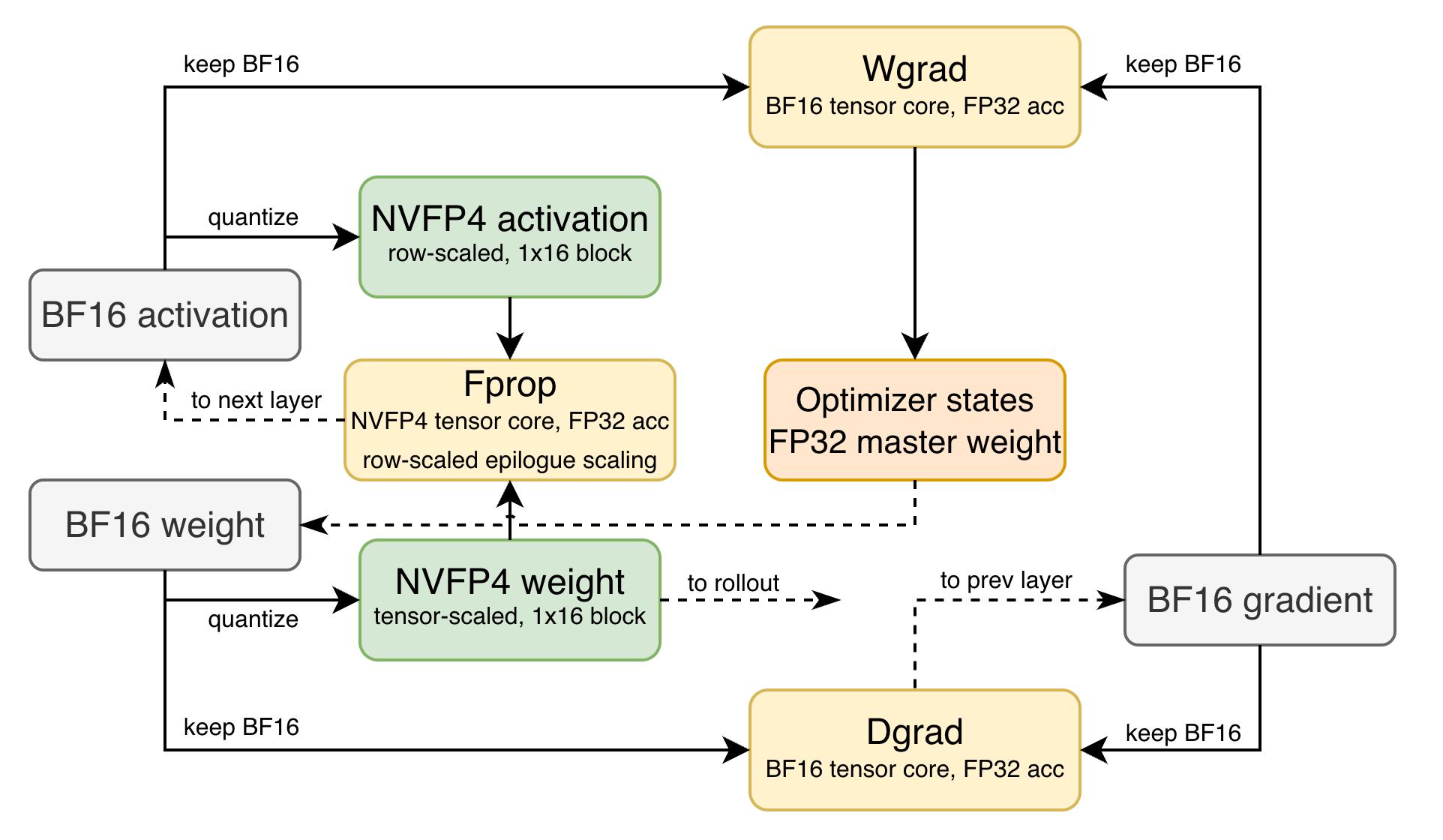
NVFP4 stores E2M1 values in 16-value blocks with an E4M3 scale for each block and an outer FP32 scale. The Miles reference recipe combines NVFP4 and BF16 through tensor-level precision configuration. Activation scaling is computed per token. Gate and up projections are quantized together so the fused rollout GEMM uses the same outer weight scale. The trainer, checkpoint converter, and rollout kernels must use the same scaling contract. Hardware: B200, B300, GB200, or GB300. Run the Qwen3-30B-A3B reference recipe with paired rollout and training flags:--fp4- prefix: NVFP4 has its own format and recipe flags rather than
reusing the --fp8- pair. The launcher also adds --optimizer-cpu-offload --overlap-cpu-optimizer-d2h-h2d --use-precision-aware-optimizer.
The base NVFP4 recipe uses high-precision backward: the forward pass uses
NVFP4 while the BF16 backward GEMMs consume the original BF16 operands.
NVTE_* recipe
environment:
num_hidden_layers from
text_config when present, otherwise the top-level config, and recognizes
model.layers, language_model.model.layers, model.language_model.layers,
and language_model.layers. First/last-layer BF16 controls apply to those
language layers. Unsupported namespaces remain unquantized. Training-time
precision is still controlled separately by --te-precision-config-file.
Advanced: dequantized backward
Dequantized backward keeps the backward GEMMs in BF16 but uses BF16 dequantizations of the NVFP4 operands produced during the forward pass. See the humans& discussion of gradient stability for the motivation and ablations.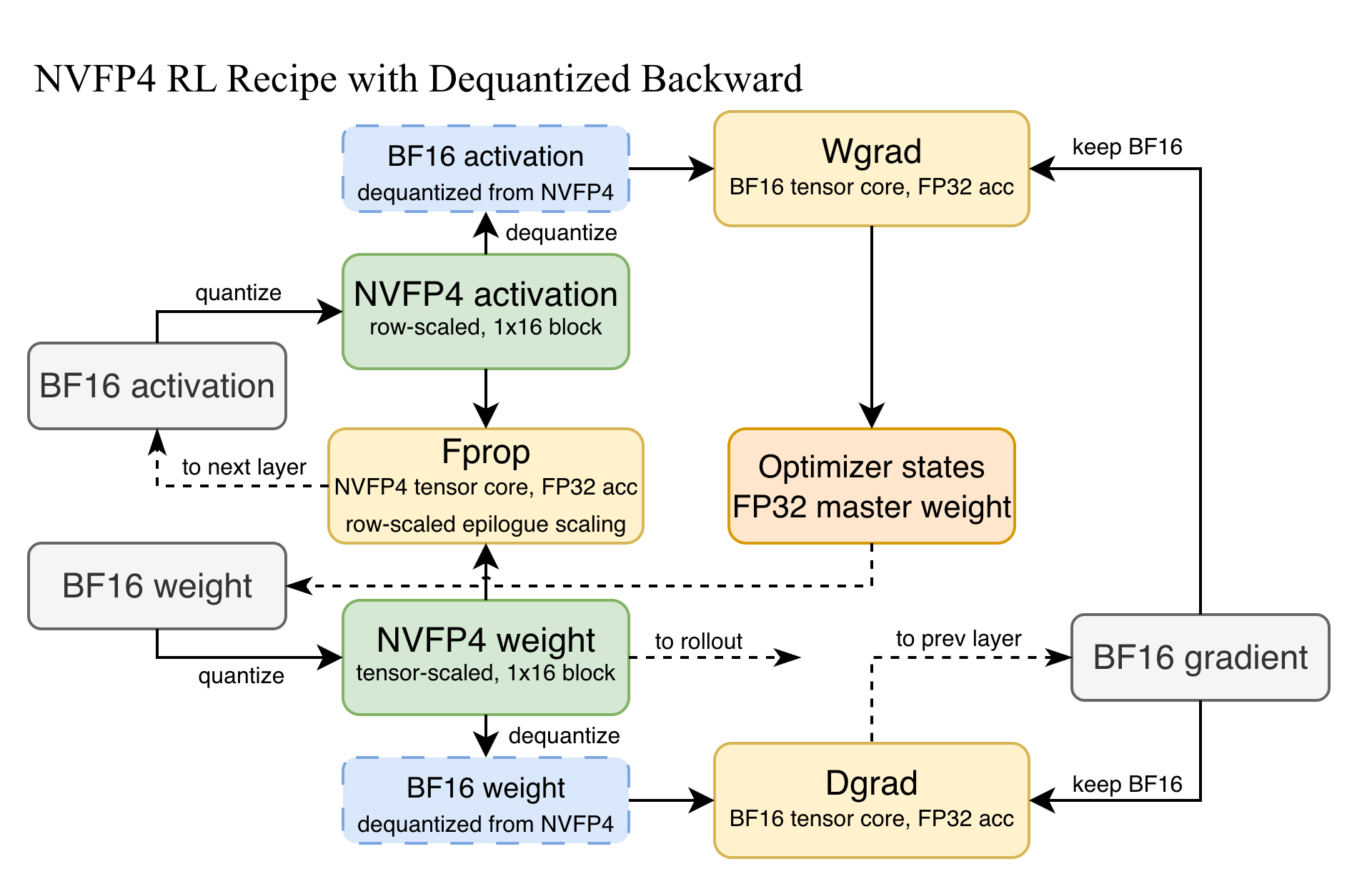
Advanced: four-over-six
Four Over Six: More Accurate NVFP4 Quantization with Adaptive Block Scaling optionally chooses, for each NVFP4 block, whether mapping the largest FP4 magnitude to 4 or 6 produces less quantization error. See the humans& four-over-six analysis for the RL recipe discussion. An example setting is:Fine-grained BF16 exceptions
Miles supports per-layer precision configuration across checkpoint conversion, Megatron training, SGLang rollout, and live weight export.
Use equivalent Hugging Face and Megatron name matchers for exceptions beyond a
recipe’s default scope. NVFP4 checkpoint conversion and live export exclude
shared experts, MTP, and non-language components automatically. Common
additional exceptions include final transformer layers and MLA projections
whose contraction axis does not match a one-dimensional scaling layout.
Hardware support
When BF16 is enough
- Dense models below ~30 B.
- A100 hardware (no FP8 GEMM).
- AMD MI300X / MI325X (no FP8 block-wise path).
- Bring-up of a new model architecture, where clean BF16 numerics simplify debugging.