

Examples
Example 1
In this script, we provide a minimal example to use true-on-policy.Example 2
This script contains more features for various use cases, and one flag is about the true on policy feature.--mode debug_minimal, which will skip evaluation and run generation with a very short output sequence length. Since true on policy is unrelated to OSL or answer correctness, this can be used for quick experiments.
Other Cases
In order to support true on policy for other cases, please refer to the flags changed in the examples above.What is Expected to Observe
After running the training, you can see in wandb that the metrictrain/train_rollout_logprob_abs_diff should be exactly 0. This indicates that there is no difference between the log probabilities from the training and the inference. Without the feature enabled, this value should be nonzero.
Setup & Results
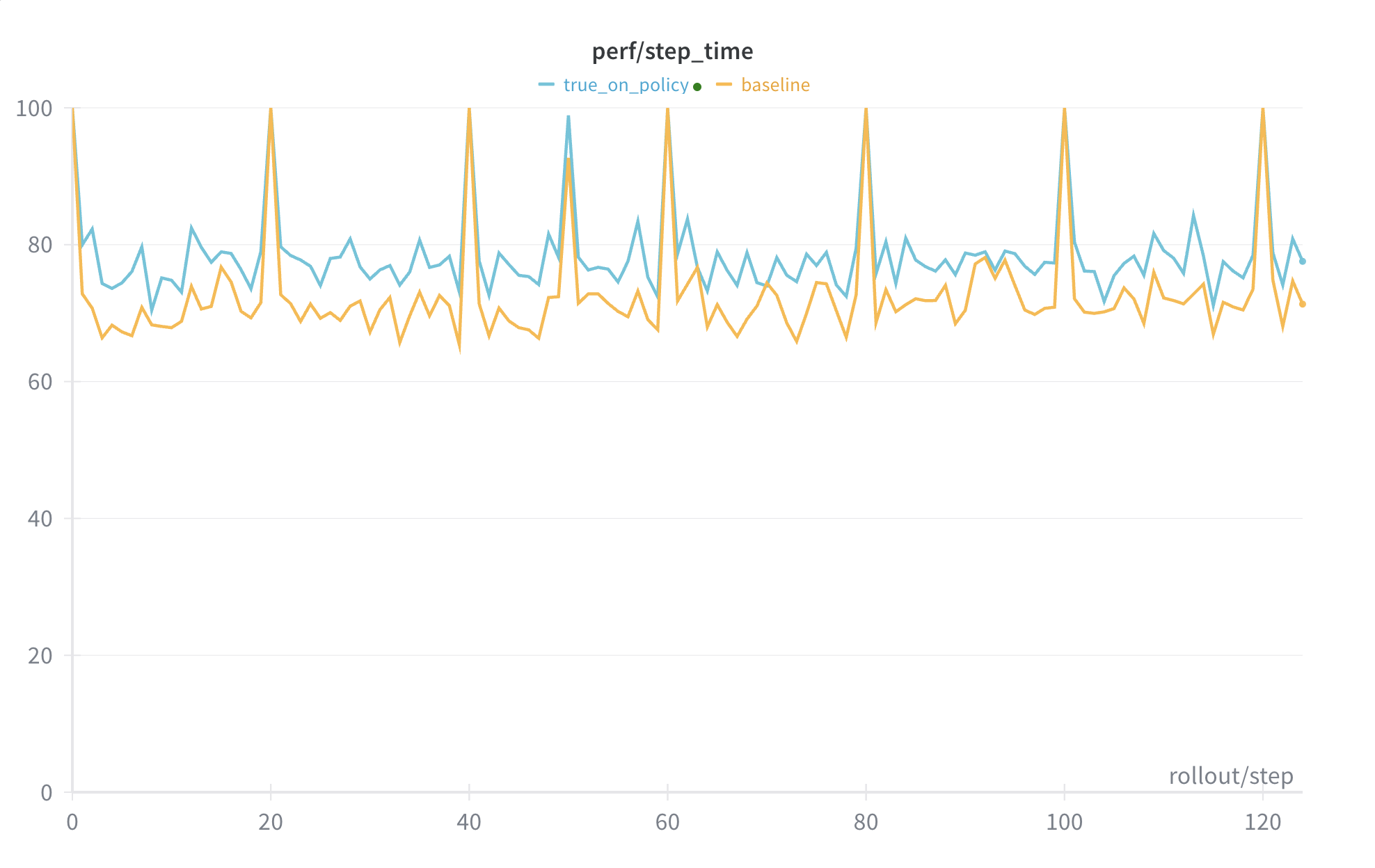
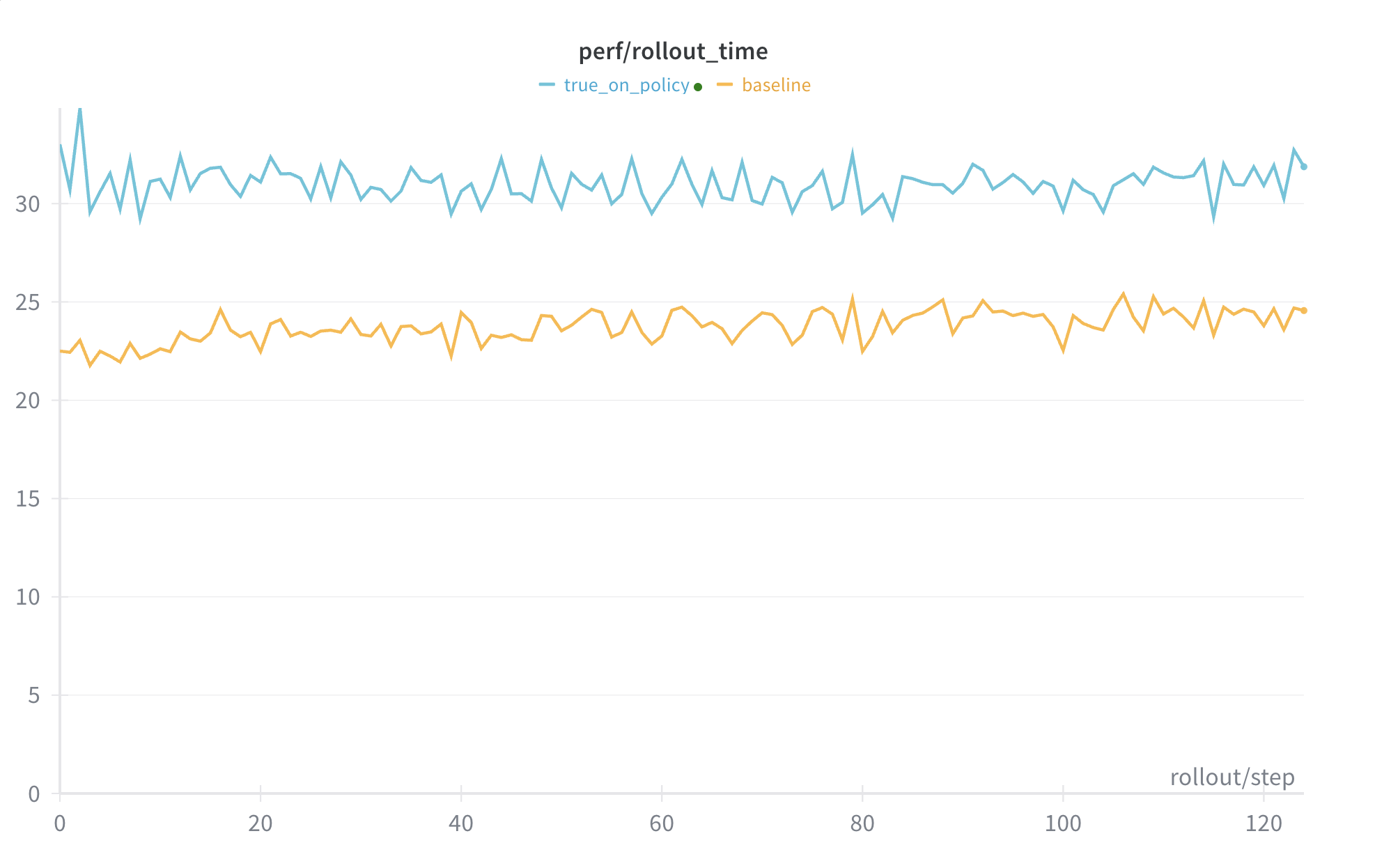
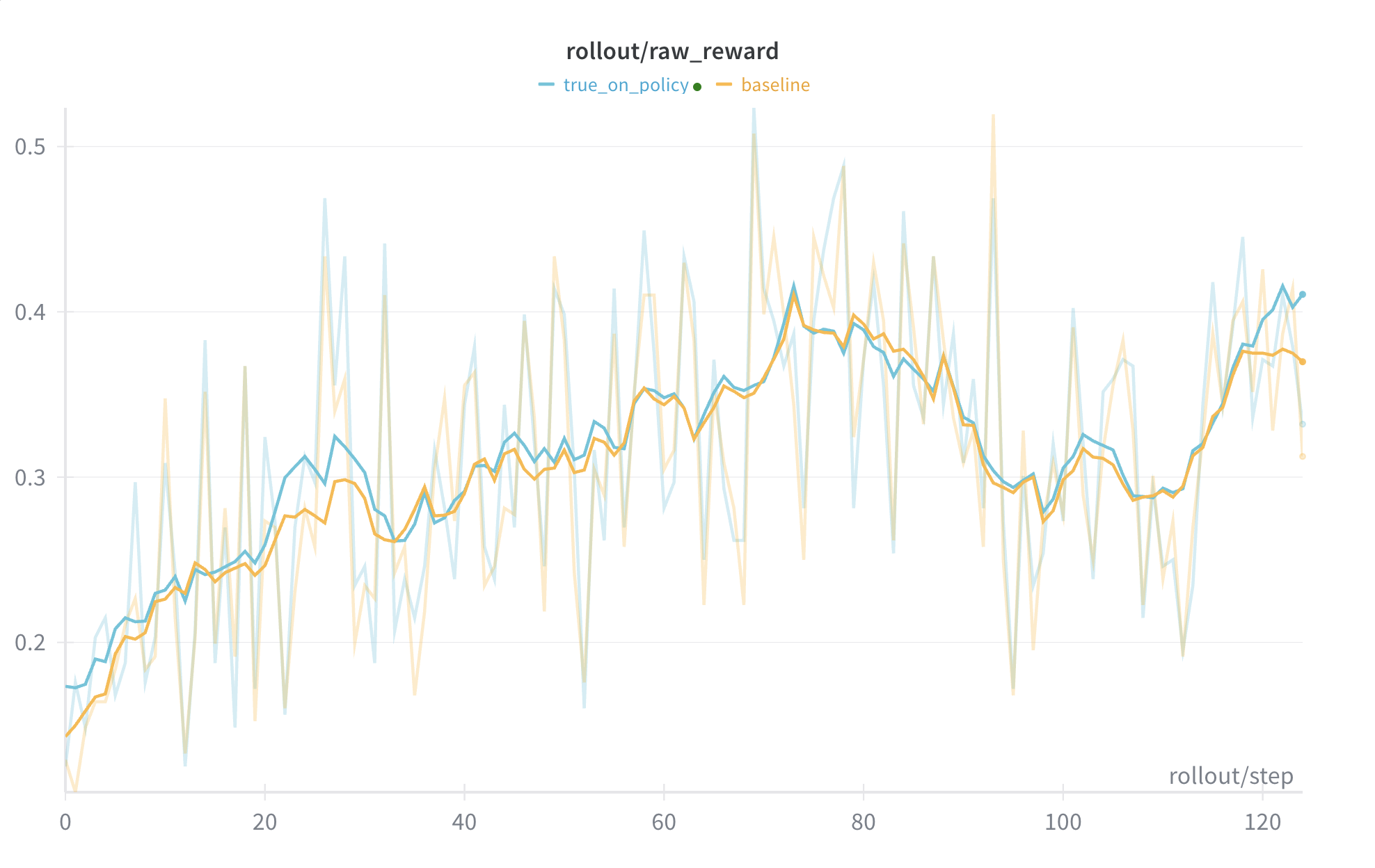
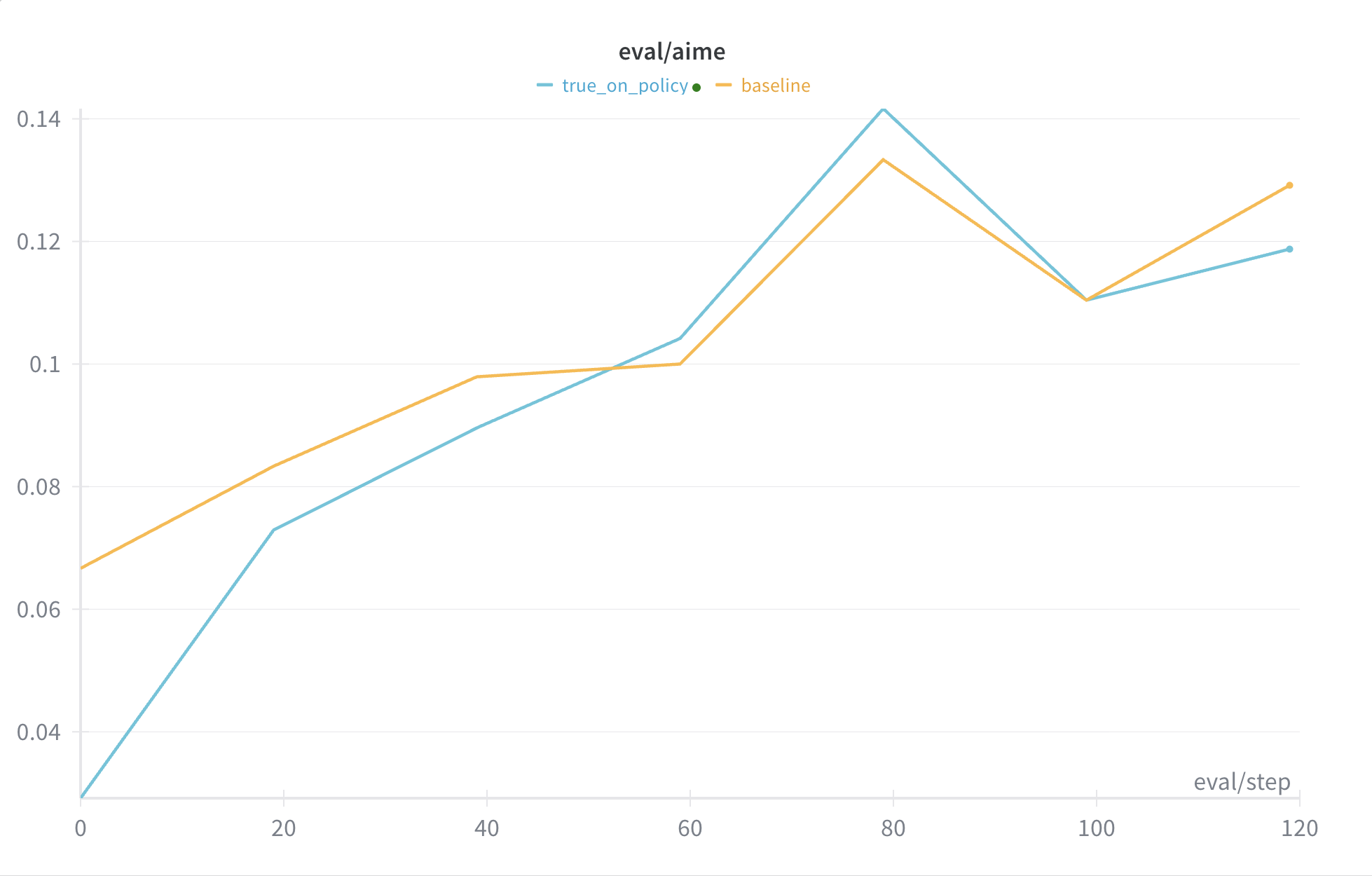
We fine-tune Qwen3-4B-Base on dapo-math-17k dataset with max_new_tokens = 2048, and evaluate on aime-2024 dataset with max_new_tokens = 8192. Global batch size is 64 × 16. Results are summarized below.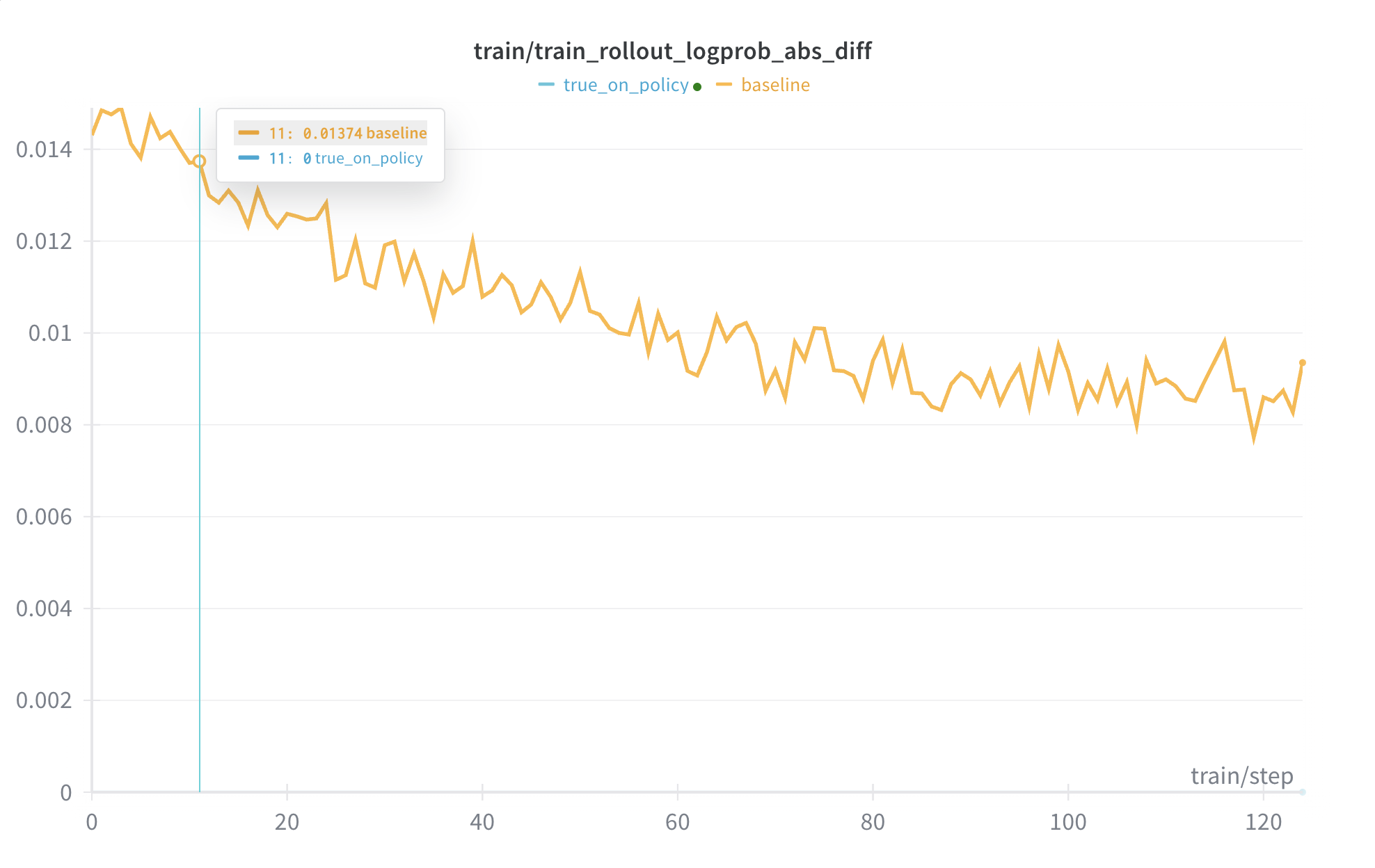
Observations
Train–inference-diff is strictly 0, verifying full numerical equivalence between training and inference forward passes. Raw rewards perfectly match the baseline, and rollout time shows an acceptable slowdown.Reproduction
Detailed reproduction refers to this.How it is Implemented
The core idea is to make each and every operation in training and inference be bitwise equal. The main code is implemented in #566 and SGLang#12058. Briefly speaking, we handled the following components to make them aligned:- Attention: We use the Flash Attention 3 backend for both training and inference, since it achieves bitwise equal between prefill and decode operations.
- GEMM: We use DeepGEMM for fast matrix multiplication while preserving true-on-policy, thanks to its algorithm to pick things like tensor core instructions (SGLang#12142).
- Batch invariant kernels: This is a prerequisite for true on-policy, and we use the ones from the Thinking Machines Lab.
- Torch compile: We also utilize
torch.compileto speed up by avoiding many tiny kernels. - We align numeric operation details between the two systems for simplicity, such as op dtype, detailed kernels, etc. Some operations can also be compiled to speedup (#603, SGLang#12161).
Future Works
We will keep maintaining and enhancing this feature. More specifically, we will:- Further validate it with more experiments, and compare it with algorithmic fixes such as TIS.
- Potentially scale it to larger scale models if it is proven to be effective.